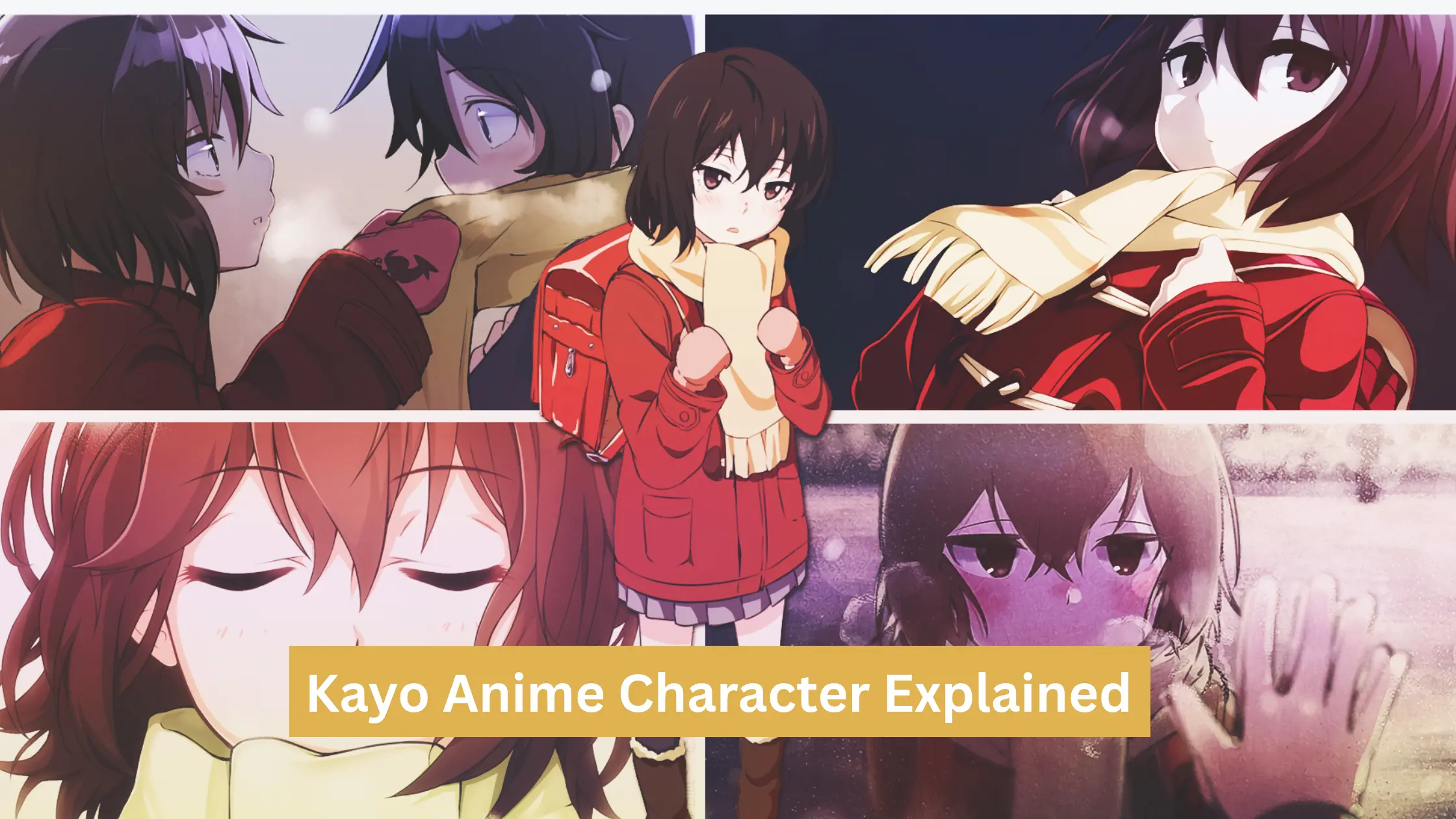
Erased is technically a time-travel thriller about a 29-year-old man trying to stop a serial killer. But ask anyone who finished it what they actually remember, and the answer is almost always the same. They remember Kayo.
Kayo Hinazuki is the closest thing Erased has to a co-protagonist. She’s the first child Satoru tries to save when his Revival ability sends him back to 1988. She’s the reason most viewers cry by episode four. And she’s the character whose story arc carries the emotional weight of the whole series, even though she ends up with someone other than the boy who saved her.
Kayo Hinazuki: Quick Facts
| Full name | Kayo Hinazuki (雛月 加代) |
| Anime | Erased / Boku Dake ga Inai Machi |
| Studio and year | A-1 Pictures, 2016 |
| Japanese voice actor | Aoi Yuki |
| Age in 1988 | Around 10 to 11 years old (fifth grade) |
| Appearance | Short brown hair, brown eyes, red coat, yellow scarf |
| Mother | Akemi Hinazuki |
| Husband (adult) | Hiromi Sugita |
| Child | Mirai Sugita (the name means “future”) |
Who is Kayo Hinazuki?
Kayo Hinazuki is a fifth grader in 1988 Hokkaido. She’s quiet. She doesn’t have friends. She wears the same red coat and yellow scarf to school every day and most of her classmates just think she’s weird. The truth is uglier than weird. She’s being beaten at home and she’s been written off by every adult in her life.
In the original 2006 timeline of Erased, Kayo is the first of three children abducted and killed by a serial killer in the spring of 1988. Her death is what sets the rest of the killing spree in motion. When Satoru Fujinuma’s Revival ability sends him back to that year, saving Kayo becomes the central task of the first half of the show.
She’s also the character most viewers fall in love with.
Kayo’s Appearance and Personality
You’ll recognize Kayo immediately if you’ve seen any screenshots from the show. The faded red coat. The yellow scarf with the orange stripe at the end. Blue socks. Brown boots. Red randoseru backpack. Sometimes pink mittens in the snow scenes. Her hair is short and brown and tends to fall over one eye.
The outfit isn’t a fashion choice. It’s the same clothes every day because that’s what’s available to her.
Her personality reads cold on first impression. She’s blunt. She calls Satoru an idiot more often than she calls him by his name. Kayo doesn’t smile at adults. She watches her classmates from the edge of the room and never asks to join them. But all of that is armor. The version of Kayo who exists with her guard down is gentle, observant, and quietly funny. The first time she eats a proper home-cooked meal at Satoru’s house, she breaks down crying because she’s never experienced that kind of kindness from an adult before.
That moment is when most viewers realize the show is going to break their hearts.
Kayo’s Backstory and Abusive Home Life
Kayo’s home life is the engine of her whole story. Her mother Akemi is physically abusive on a level that the show does not look away from. There are bruises. There are scenes of Kayo locked in a shed in the cold. There’s at least one moment where her life is in real danger from her own mother, not from the kidnapper.
The reasons are messy. Akemi was abandoned by Kayo’s father and ended up with a new boyfriend who didn’t want a kid around. The abuse comes from a mix of resentment, isolation, and her own inability to cope. The show never tries to excuse any of it. It just shows you how a kid like Kayo ends up where she is.
Kayo learned to numb her own emotions early. She told herself that if she didn’t react, her mother would have less reason to hit her. By the time we meet her at age ten, she has already stopped expecting kindness from anyone. She believes Satoru and herself are both “fakes” because they pretend to be normal kids when they aren’t. Hers is the act of survival. His is just the act of a lonely adult version of himself trapped in a child’s body.
Kayo’s Role in Erased (Boku Dake ga Inai Machi)
Kayo is one of three children kidnapped and murdered by a serial killer in early 1988. Satoru, as an adult mangaka, has only vague memories of her. He remembers a quiet classmate who disappeared and he remembers that he never tried to befriend her when he had the chance.
When Revival sends his consciousness back to age ten, he gets that chance again. The first arc of the show is built almost entirely around his attempt to save her. He approaches her at recess. He invites her over after school. Their plants himself between her and the world, badly at first, then more naturally as she starts to open up.
The arc works because it isn’t really about the kidnapper at all. It’s about a kid getting one adult who decides to pay attention to her, and what that small thing does. Satoru’s reasons for saving Kayo shift from “I need to stop the killer” to “I cannot let this person disappear from the world.” That shift is the emotional spine of the entire series.
The Island Poem and What It Symbolizes
There’s a scene early in the show where Kayo writes a poem for class. It’s the most quoted piece of writing in the entire series and probably the line most fans end up keeping screenshots of.
The poem describes an island far away. An island with no people on it. An island where she can climb a tree when she wants, swim in the sea when she wants, sleep when she wants. The line that hits hardest is the one about wanting to go somewhere with no pain and no sadness. She titles the piece “The Town Without Me.”
Her teacher praises the writing. None of the adults around her read it for what it actually is.
The poem is a child’s way of telling you she wants to disappear. The island isn’t an escape fantasy in the way a normal kid might daydream about Disneyland. It’s the only future Kayo can imagine where her mother isn’t in it. Reading it again after you’ve finished the show is the kind of thing that quietly ruins your afternoon.
Why Kayo Married Hiromi Instead of Satoru
This is the question that splits the Erased fandom right down the middle.
After Satoru wakes up from a fifteen-year coma at the end of the series, he finds out Kayo is married. To Hiromi Sugita. They have a baby. The baby’s name is Mirai. Plenty of viewers walked away from that ending angry. They felt cheated out of the Kayo-and-Satoru endgame the first arc had built up.
Here’s the thing. The bond Kayo and Satoru share as kids is real, but it’s the bond of one child being saved by another child. The romantic version of that pairing lives more in the audience’s head than in the show itself. Kayo doesn’t owe Satoru her adult life. She owes him her gratitude. Those are different things.
Hiromi is also worth thinking about. In the original timeline, Hiromi is one of the children murdered by the killer. In the altered timeline created by Satoru’s actions, Hiromi survives and eventually marries Kayo. The marriage between Kayo and Hiromi is two survivors of the same trauma building something normal together. The baby being named Mirai, which means “future,” is the show’s way of telling you that Satoru’s sacrifice gave them exactly that. A future.
The ending lands differently once you stop expecting it to be a love story.
Kayo as an Adult and Where She Ended Up
Adult Kayo is one of the most quietly satisfying character payoffs in modern anime. She has a husband she loves. Kayo has a child she clearly adores. She visits Satoru in the hospital throughout his fifteen-year coma and helps his mother Sachiko keep him company. When he finally wakes up, she tells him she got the happiness she never thought was possible.
The visual the show picks for this is deliberate. The first time Satoru sees adult Kayo after fifteen years, she’s holding her baby and smiling. That smile is the entire point. The kid who wrote a poem about wanting to disappear from the world ended up choosing to stay in it.
That’s the actual ending of her arc. The marriage is a detail. The smile is the story.
Anime vs Manga Differences for Kayo’s arc
The anime is a mostly faithful adaptation but it’s not identical to the manga. The relevant differences for Kayo are these.
Kayo transfers to a new school after the events of 1988. The show uses this to move her off-screen so the second half can focus on the killer reveal. In the manga, Kayo stays in the same school. That choice changes the social dynamics in the years after the rescue and feels a little more grounded.
The relationship between Kayo and Hiromi is also developed more gradually in the manga. The anime, working with only twelve episodes, essentially time-skips from “Kayo is safe” to “Kayo is married with a baby” and asks you to fill in the middle yourself. The manga shows more of that middle. If the ending of the anime felt rushed to you, the manga is worth reading for that reason alone.
The core of Kayo’s character is the same in both versions. The poem. The abuse. The rescue. The eventual happiness. The differences are mostly about pacing and how much room each format had to show her healing.
Kayo Anime Character FAQs
1. Who voices Kayo Hinazuki in Erased?
Aoi Yuki voices Kayo in Japanese. She’s known for roles like Madoka in Madoka Magica and Tanya in The Saga of Tanya the Evil. Her work as Kayo is some of the most restrained and effective in her career. There’s a vulnerability in her voice during the abuse scenes that does a lot of heavy lifting for the show.
2. Why did Kayo marry Hiromi and not Satoru?
Because Satoru spent fifteen years in a coma and Kayo built a life in the meantime. The Kayo and Satoru relationship was a deep childhood bond, not a romance. Hiromi was also someone Satoru saved indirectly in the original timeline. Their marriage is two survivors choosing a future together. The baby’s name (Mirai, meaning “future”) underlines that point.
3. What happens to Kayo at the end of Erased?
She’s alive, married, raising a child, and visibly happy when Satoru wakes up from his coma. She’s been visiting him in the hospital for years and is close with his mother Sachiko. The reunion is bittersweet but ultimately framed as the success of Satoru’s mission, not a failure of it.
4. Is Kayo’s mother a real villain in Erased?
Yes. Akemi Hinazuki is one of the story’s central antagonistic figures because of the physical abuse and neglect she inflicts on Kayo. Her actions place her daughter’s safety at serious risk, even apart from the threat posed by the serial killer.
5. What does Kayo’s island poem mean?
It’s the cleanest expression in the show of Kayo’s wish to escape. The island has no people, no pain, and no sadness. It’s not a daydream about vacation. It’s a child trying to put suicidal ideation into language safe enough that an adult might miss it. The teacher praises the writing without seeing what’s underneath. That’s the point of the scene.