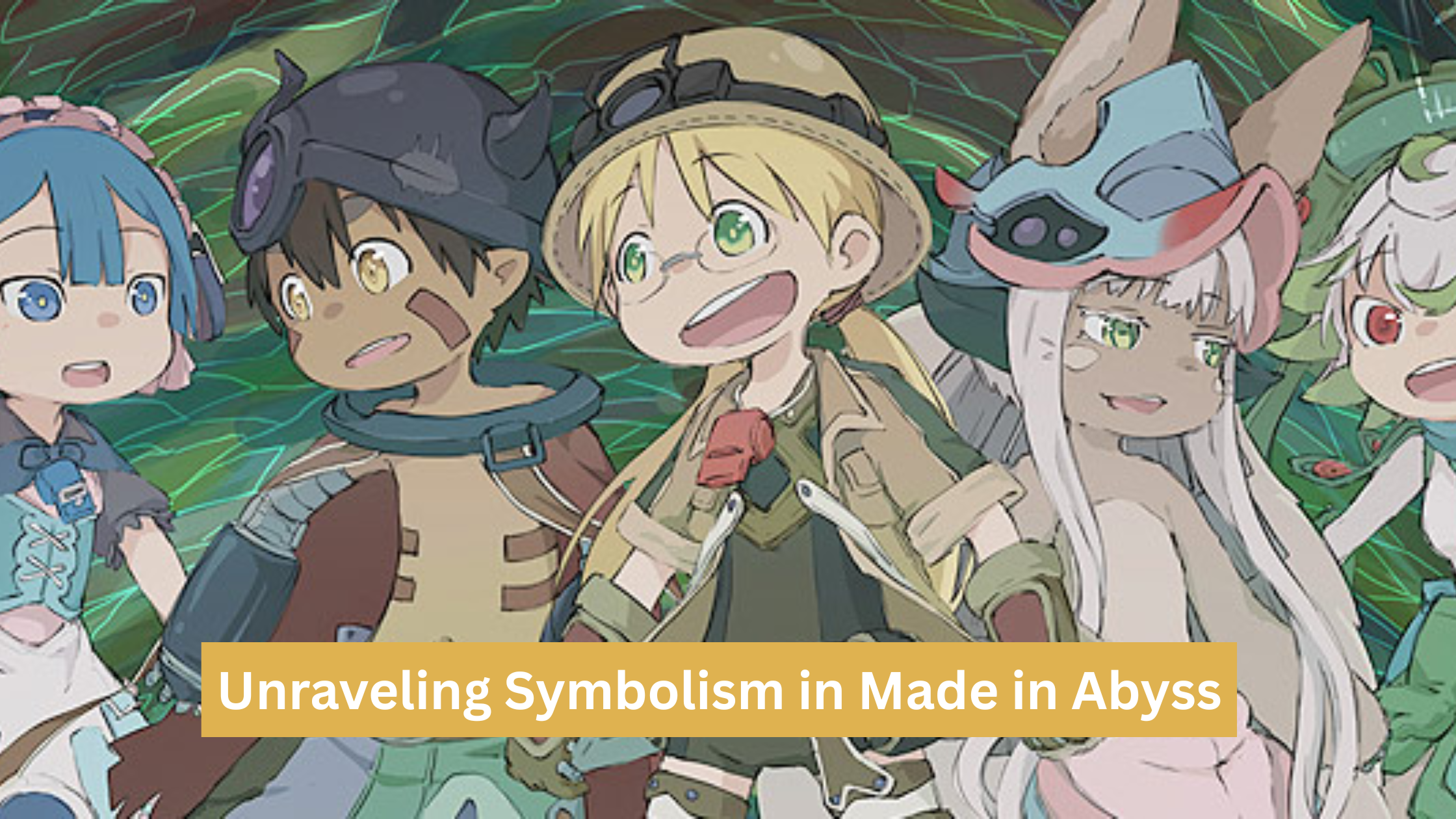
Few anime manage to capture beauty and horror in such perfect harmony as Made in Abyss. On the surface, it looks like a grand adventure — a young girl named Riko and her robot companion Reg exploring a mysterious, vertical world full of monsters, relics, and ancient wonders. But beneath that innocent setup lies something much deeper.
Made in Abyss is not just a fantasy tale. It’s a philosophical journey about human curiosity, pain, morality, and the cost of knowledge. Every layer of the Abyss symbolizes a descent into the human mind itself — where wonder and terror coexist, and every discovery comes with a price.
In this exploration, we’ll unravel the symbolism behind Made in Abyss, from its haunting metaphors to the emotional design that makes it both breathtaking and devastating.
Metaphor of the Abyss as Human Curiosity
At its core, Made in Abyss is a story about the insatiable hunger to know more. The Abyss itself represents human curiosity — vast, alluring, and unforgiving. The deeper one goes, the more dangerous it becomes. And yet, explorers keep descending.
This mirrors our own world perfectly. Humanity’s greatest achievements often come from our refusal to stop asking questions — but that same curiosity can lead to ruin. Whether it’s scientific ambition or personal desire, Made in Abyss reminds us that every “leap into the unknown” carries consequences.
Riko’s journey isn’t just about finding her mother; it’s about confronting that boundless thirst for knowledge. The Abyss tempts her with wonders but punishes every step. In this sense, the series beautifully captures the duality of exploration — the joy of discovery and the inevitability of suffering.
Relationship Between Pain and Growth
Pain in Made in Abyss isn’t just physical — it’s emotional, moral, and psychological. Every character suffers, and yet, every moment of pain pushes them toward growth.
Riko’s injuries, Reg’s guilt, and Nanachi’s trauma all highlight how transformation comes through suffering. The “Curse of the Abyss,” which punishes anyone who ascends after descending, becomes a powerful metaphor. It tells us that once you’ve seen the depths — whether of knowledge, emotion, or experience — you can never return unchanged.
The pain of ascent is the pain of growth. It’s the price of enlightenment. Made in Abyss doesn’t glorify suffering; it portrays it as an inevitable part of evolution. The deeper you go — both in the Abyss and within yourself — the more it hurts, but the more you understand.
Innocence Contrasted with Danger
One of the most striking elements of Made in Abyss is its contrast between childlike innocence and brutal horror. The characters look adorable, almost like they belong in a children’s show, but the events they endure are anything but gentle.
This deliberate artistic decision creates a jarring dissonance — one that amplifies the emotional impact. The childlike art style lulls viewers into a false sense of safety, making the violence and despair hit even harder.
Riko’s bright optimism and Reg’s gentle heart clash with the cruel realities of the Abyss. Through this contrast, the series explores how innocence doesn’t protect one from pain — it makes the experience of pain even more profound.
It’s a reminder that growing up means losing the safety of illusion. And Made in Abyss captures that loss in the most haunting way possible.
World-Building as Emotional Manipulation
The world of Made in Abyss is stunningly beautiful — and that’s what makes it so dangerous. Every detail, from glowing fauna to haunting ruins, is designed to evoke awe. But that beauty is deceptive.
This is where the series’ world-building turns into emotional manipulation. The deeper the characters go, the more breathtaking their surroundings become — and the more perilous their situation gets.
It’s an intentional trick by the creators. The world lures not only Riko and Reg, but also the viewers. We fall in love with the beauty of the Abyss, only to be reminded that beauty and danger often walk hand in hand.
This emotional whiplash keeps viewers conflicted — we want the characters to continue, even though we fear what they’ll find next. That balance of wonder and dread is what gives Made in Abyss its unique, almost hypnotic power.
Character Arcs of Discovery and Trauma
Every major character in Made in Abyss embodies a different kind of trauma and discovery.
- Riko represents pure curiosity — the drive to explore no matter the risk. Her optimism borders on recklessness, showing the danger of blind ambition.
- Reg embodies guilt and confusion. His mechanical nature raises questions about identity, memory, and humanity. He’s a being of power struggling to understand his purpose.
- Nanachi, perhaps the most emotionally complex, reflects the consequences of human cruelty. Their backstory with Mitty is one of anime’s most heart-wrenching portrayals of love and loss.
Through them, the series explores how discovery often brings trauma. Yet, despite everything, they keep moving. Their resilience turns tragedy into quiet heroism.
Each descent becomes a mirror for the human condition — a reminder that even in despair, we search for meaning.
Sound and Silence Narrative Design
The sound design in Made in Abyss is a character in itself. The series uses music and silence to manipulate emotion with surgical precision.
Composer Kevin Penkin’s score blends ambient soundscapes with haunting melodies that mirror the emotional rhythm of each scene. When wonder fills the air, the soundtrack swells with ethereal notes. When despair takes over, silence often does the talking.
That contrast between sound and quiet mirrors the emotional tension of exploration. In the depths of the Abyss, silence isn’t peace — it’s pressure. It’s the stillness before discovery or death.
The way Made in Abyss uses audio creates an immersive experience. It reminds viewers that storytelling isn’t only visual — it’s sensory. You don’t just watch the Abyss; you feel it closing in.
The Abyss as a Psychological Metaphor
The Abyss isn’t just a physical place — it’s a psychological one. It symbolizes the subconscious mind — vast, mysterious, and layered with buried fears.
Each layer of the Abyss mirrors a stage of psychological descent. The further the characters go, the more they confront not monsters, but themselves. Their doubts, traumas, and desires take tangible forms.
This interpretation aligns with Jungian psychology — the idea that to find enlightenment, one must first face the darkness within. In Made in Abyss, the journey downward is not about escaping the world but understanding it — and oneself — completely.
By the time Riko and Reg reach the deeper layers, it becomes clear: the Abyss is not a place to conquer. It’s a truth to accept.
Criticism of Moral Ambiguity
One of the most debated aspects of Made in Abyss is its moral ambiguity. The series doesn’t paint clear heroes or villains. Instead, it presents actions in shades of gray.
Characters like Bondrewd, the “Lord of Dawn,” embody this perfectly. He commits horrifying acts in the name of progress, blending cruelty and genius in a way that unsettles viewers. His experiments are monstrous, yet his motives stem from a twisted form of love and devotion.
This ambiguity forces viewers to confront uncomfortable questions:
How far is too far in the pursuit of knowledge? Is morality absolute, or does it shift with purpose?
By refusing to provide easy answers, Made in Abyss becomes a critique of humanity’s ethical boundaries. It shows that progress often demands sacrifice — but asks whether that sacrifice is ever justified.
Why It Emotionally Drains Yet Fascinates
Watching Made in Abyss is an emotional paradox. It hurts — yet you can’t look away. The series drains you because it reflects reality in its rawest form.
Life, like the Abyss, is full of beauty and pain. The anime doesn’t offer escapism; it offers confrontation. It asks viewers to witness innocence colliding with cruelty, and still find meaning in the aftermath.
This emotional exhaustion is intentional. By the end of each arc, viewers feel as if they’ve descended too — carrying the weight of the characters’ experiences. But that’s also what makes the series unforgettable.
Few stories dare to be this honest about suffering. Made in Abyss doesn’t shield us from pain; it teaches us to see beauty within it.
Viewer Interpretation Diversity
What makes Made in Abyss extraordinary is that every viewer sees it differently. Some interpret it as a story of adventure, others as a tragedy about human obsession. Some see hope in Riko’s courage; others see a warning about ambition.
The open-ended symbolism allows for a wide range of interpretations. The Abyss can represent curiosity, grief, depression, enlightenment, or even the afterlife. This flexibility invites discussion and personal reflection.
That’s why the anime continues to inspire essays, debates, and art. It speaks differently to every generation, every personality, and every emotional state.
Like the Abyss itself, Made in Abyss becomes whatever you bring into it — wonder, fear, or longing.
Conclusion
Made in Abyss is more than a dark fantasy. It’s a mirror that reflects the most vulnerable parts of being human — our curiosity, our pain, our need to understand.
Through its layered storytelling, haunting music, and emotional honesty, it transforms a journey into the unknown into a metaphor for life itself. The Abyss tempts, terrifies, and transforms — just like our own search for meaning.
In the end, the series teaches a powerful truth: discovery always demands sacrifice, and the deepest journeys are never just downward — they are inward.
And that’s why Made in Abyss will always linger in our minds long after the credits fade — a haunting reminder that beauty and suffering are often one and the same.